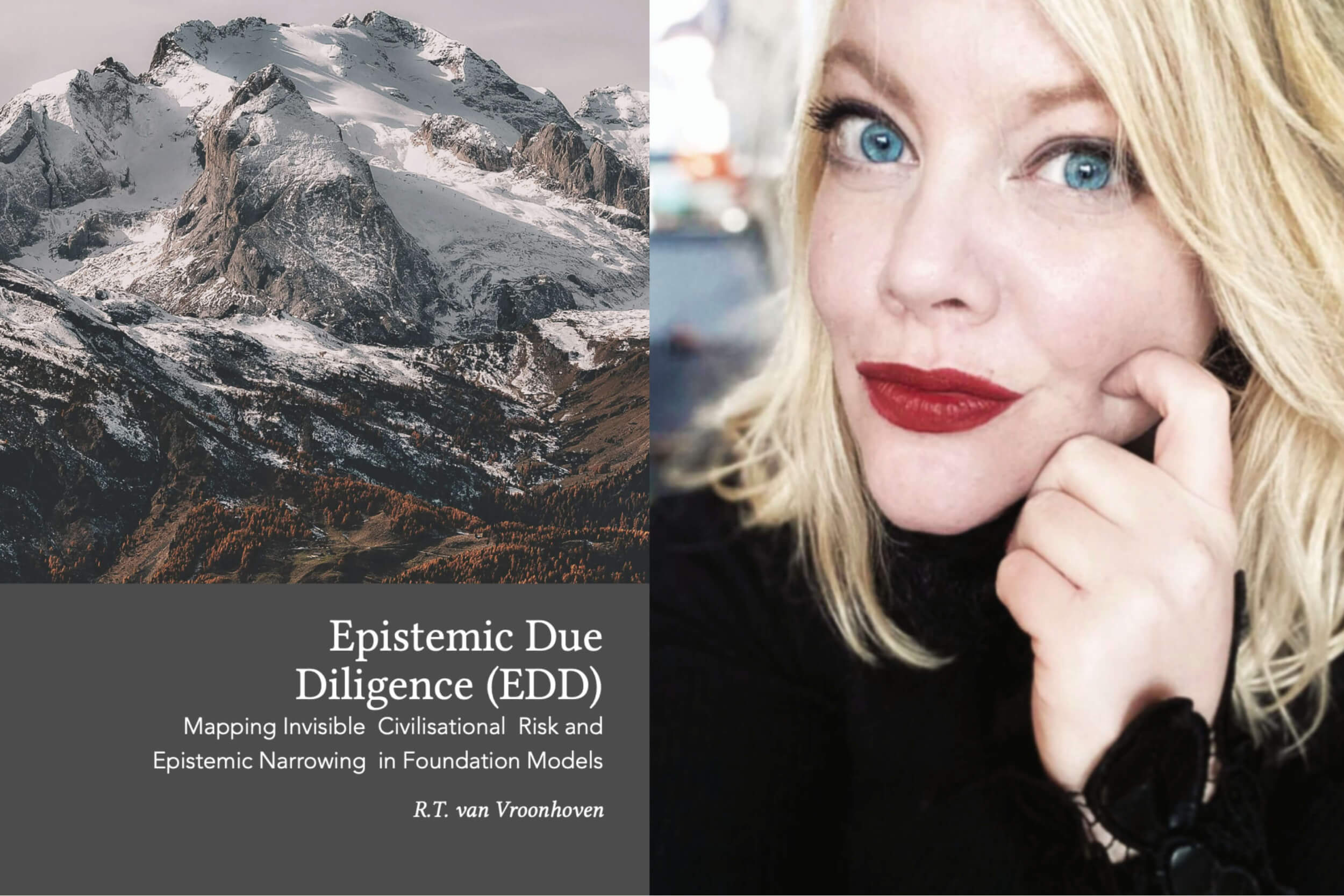
My thesis is called Epistemic Due Diligence (EDD) : Mapping Invisible Civilisational Risk and Epistemic Narrowing in Foundation Models.
Modern institutions depend on legibility: simplifying complex realities into categories, metrics, and records to coordinate at scale. These processes create epistemic filters that shape what counts as evidence. Quantifiable, codifiable knowledge passes easily; tacit, embodied, and relational understanding remains invisible or burdened by translation.
Foundation models intensify this. Trained on historically filtered data, they inherit the biases of what has been digitised and preserved. As these systems mediate search, classification, and decision-making, they risk consolidating existing filters into shared infrastructure—producing epistemic narrowing: knowledge systems become progressively dependent on patterns legible to models, while resistant forms of knowing are systematically excluded.
Epistemic Due Diligence (EDD) is a tentative framework for governing these risks. It focuses upstream on epistemic infrastructure through four diagnostic questions:
Whose knowledge is excluded or heavily burdened? What forms of knowledge remain outside the frame entirely?Who has authority to define what counts as evidence? Which decisions should remain revisable under uncertainty? Applied across data design, development, and deployment, these questions treat absences not as missing data but as signals of structural exclusion. EDD aims to support knowledge systems accountable to what they cannot easily capture.
Link to thesis: https://rtvanvroonhoven.com/epistemic-due-diligence-edd/
I am most proud of going from a vague, abstract concept, to a reasonably clear version zero of a whitepaper in these 12 weeks. I truly believe a pressure-cooker process where you do not have to go through it alone, is incredibly helpful in staying accountable and getting to actual results.
Being more open about my process also helped me find a job through the 80,000 hours job board. I am very excited to start my new role with the Odyssean Institute straight after this program!
Effective Thesis gave me a very different way of looking at the concept of a thesis: it does not just ask you if your area of research is interesting, but also if it actually makes an impact, and how it would benefit the world, your community, and yourself. It consistently helps you find stakeholders, ask “the outside questions”, and not get stuck in endless internal deliberation. This means I was able to move through a complex process much more efficiently - and with a much more exciting result!
Finding likeminded people, collaborators and community. It has been incredibly valuable to be surrounded by such a supportive, curious community. What was also very helpful was the sense of structure of a pre-established program. The fact that we were taken through a tested format step by step really helped me feel I could actually accomplish this!
When something in a system makes you uncomfortable, but you can not find the words; go look for those words. This is truly often where the hardest problems can be found - and you will never be there alone.
Whether you’re a student, expert, or organistion, join us in supporting the next generation of people using research and their careers to tackle global challenges.