
Your thesis is one of the biggest projects you’ll take on as a student - often hundreds of hours of work. We think that this dimension of impact (i.e., how your thesis influences YOU) is often underestimated and discounted. Even if it doesn’t directly “save the world”, your thesis can still be incredibly impactful if it empowers and supports your journey towards impact as a whole! This can include helping you to:
Common pitfalls here may include:
💡 Tip: Even a thesis that doesn’t solve a global problem can be highly impactful if it helps you test your fit, develop skills, and gain connections toward a high-impact career. Think of your thesis as not just an academic requirement, but a stepping stone toward a high-impact career, where the skills and insights you gain now can shape your long-term contribution to the world.
One of the most effective ways to align your thesis with your high-impact career path is to collaborate with people or organisations who are already working in a problem area you care about and that you may like to work with in the future. Early in your career, the biggest bottlenecks are often a lack of connections, opportunities, and clarity about fit. You can design your thesis to directly address all three!
Instead of starting only with “What research question should I answer?”, consider asking: “Who do I want to work with, and how could I shape a research question together with them?”
Collaboration doesn’t have to mean formal co-authorship. It could look like expert interviews, working on a research question they’ve identified as important, producing a deliverable that they can directly use for their mission, and more! Importantly, this approach is not only great for your career path, but it also increases the likelihood that your thesis will actually have an impact.
We will be focusing more on how you can create such collaborations for yourself through this program. For now, begin thinking about the organisations and individuals you would love to work with and for!
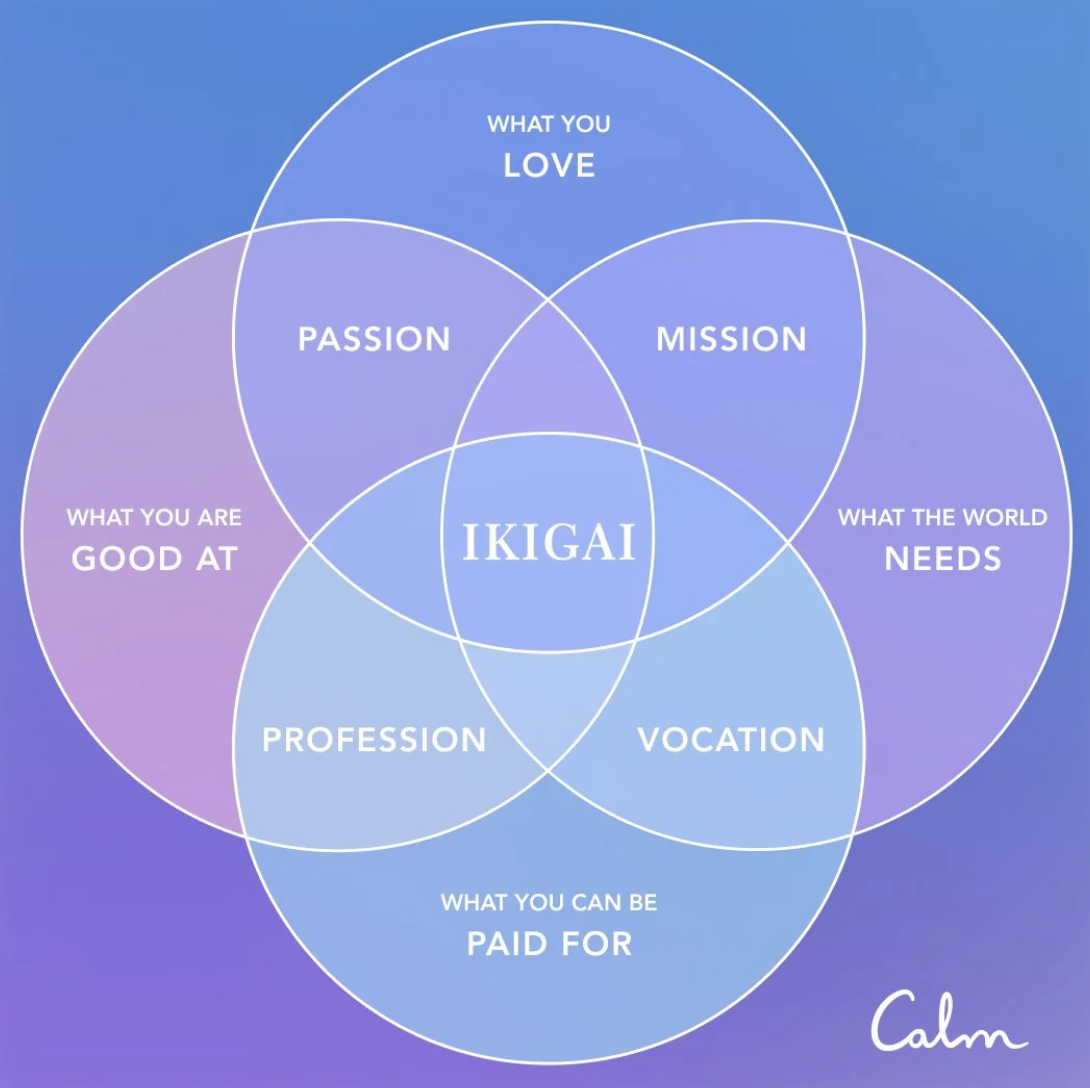
As part of this program, we’d like to introduce the concept of Ikigai - a Japanese concept and long-standing philosophy that is linked to meaning, purpose, and even longevity (with this philosophy being practiced in some of the longest-living communities in the world!). We introduce Ikigai here in Week 1 because it provides a useful foundation for discovering a vision of impact that is uniquely yours.
Ikigai is derived from the Japanese words “iki” (life) and “gai” (value or worth). It is often translated as “a reason for being” - a way of articulating what makes life feel meaningful and worth living.
The Ikigai diagram is usually represented as four overlapping circles, each representing one of the key dimensions of meaning and purpose. Where all four circles overlap is your Ikigai: the sweet spot where your interests, abilities, contribution to the world, and sustainable path align. These dimensions are:
Which career paths could actually fulfill your Ikigai, in other words, ones that draw on what you're good at, meet what the world needs, feel like what you love, and are genuinely something you can be paid for? This is something we hope that you could use your thesis for as a mini experiment for crafting this path for yourself!
Some key notes when thinking about your career path:
Here's a list worth looking through for this week's worksheet, not to pick from right now, but to surface ideas you might not have considered yet. Take some time to read through some of the profiles below that interest you, and pick one or two random profiles to skim through. Some helpful resources before going into specific paths:

Not every high-impact career involves working directly on a cause. Some people choose a high-earning career specifically so they can donate a significant share of their income to highly effective charities, and organisations like Giving What We Can (GWWC) support this path through giving pledges and charity recommendations. Others also continue to donate even while working on direct causes. Some of the people doing the most good are doing it through their wallet, not just their job title!
You can take the pledge here as a student and read why take the pledge and taking the pledge as a student first if you’re curious!
