Stakeholder mapping is a tool that helps you identify WHO needs to act for your chosen problem to be solved, and HOW your research can lead to changes in their actions/decisions.
For this week, we’ll be asking directly: if I answered this research question well, who would actually need to know about it, or be in a position to act on it?
Why Perform Stakeholder Mapping?
Stakeholder mapping is essential because it helps you understand who you are ultimately trying to help through your research and how to engage with them in the real world. It connects your theoretical Theory of Change to the actual actors who can use your findings, ensuring your thesis is aligned, actionable, and positioned to have a meaningful impact rather than staying purely theoretical. Through this, you can:
Identify collaborators and interviewees: Find individuals, organizations, or groups already engaged in the problem with whom you can partner or interview.
Spot gaps and neglected areas: Mapping helps you identify areas where few actors are working or where efforts may be failing. These gaps reveal high-potential pathways where your contribution could make a unique difference.
Make your Theory of Change real: Stakeholder mapping helps you define exactly who you want to impact - not just in theory, but in the real world! For example, if your ToC depends on policymakers changing decisions or think tanks adopting recommendations, stakeholder mapping helps you identify which specific policymakers or think tanks matter and whether you can realistically engage with them now. This makes your pathway concrete and actionable.
Understand stakeholders’ real needs: Engaging directly with stakeholders lets you learn what they truly need in practice, rather than relying on assumptions or theory. This ensures your research addresses real-world problems and creates actionable impact.
Categories of Stakeholders
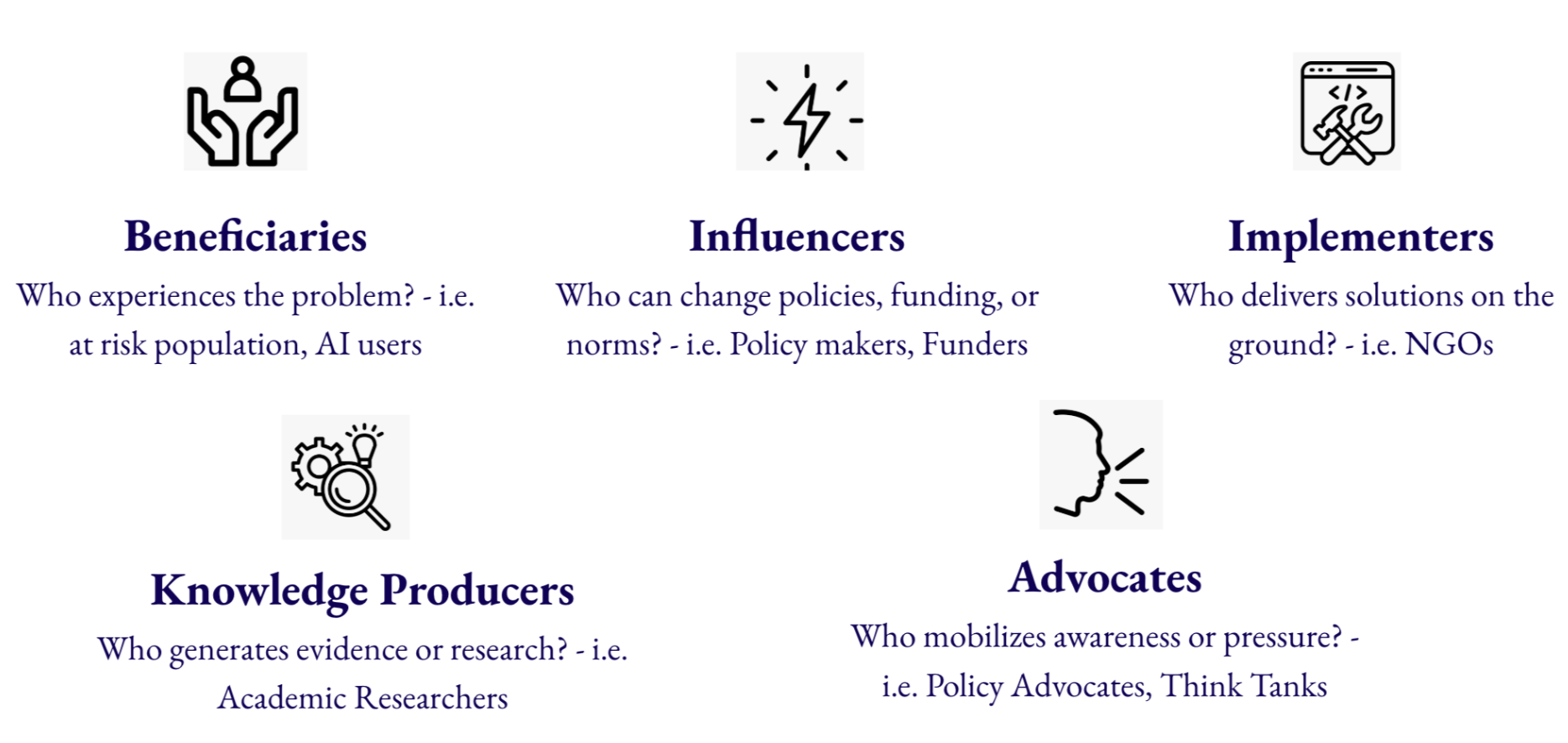
Here are a few examples of categories of stakeholders you may consider when thinking about your research area:
1. Beneficiaries: Who experiences and is impacted by the problem you are trying to solve? Examples: Patients, communities affected by environmental hazards, employees in unsafe conditions, users of AI systems.
2. Knowledge Producers: Who generates evidence or research around the problem? Examples: Academic researchers, think tanks, policy institutes, and labs.
3. Implementers: Who delivers solutions on the ground? Examples: NGOs, local governments, service providers, program managers.
4. Influencers: Who can change policies, funding, or norms? Examples: Policy think tanks, Policymakers, regulators, funders, investors, international bodies (e.g., UN, WHO).
5. Advocates: Who mobilizes awareness or pressure? Examples: Advocacy groups, journalists, grassroots movements, social media influencers.
6. Status Quo Actors: Who contributes to the persistence of the problem? Examples: Companies ignoring safety standards, governments enforcing harmful policies, and organizations maintaining harmful practices.
Connecting to your Bottleneck Mapping
You can also link your bottleneck analysis and stakeholder mapping together because, depending on your problem’s bottleneck, this will point to a different set of stakeholders who matter most for solving the problem. Not all stakeholders would be equally important for you to engage with, and this can help you narrow down your focus too!
For example, if the bottleneck is a lack of understanding, your key stakeholders might be academic researchers who can generate evidence, and the communities experiencing the problem, who can tell you what’s really happening on the ground.
However, if the bottleneck is a lack of implementation, the stakeholders shift to NGOs, policymakers, funders, or advocacy groups who can actually put solutions into practice. In this case, just focusing on generating more academic research will likely be low impact, given that this isn’t what is required to move the needle on the problem.
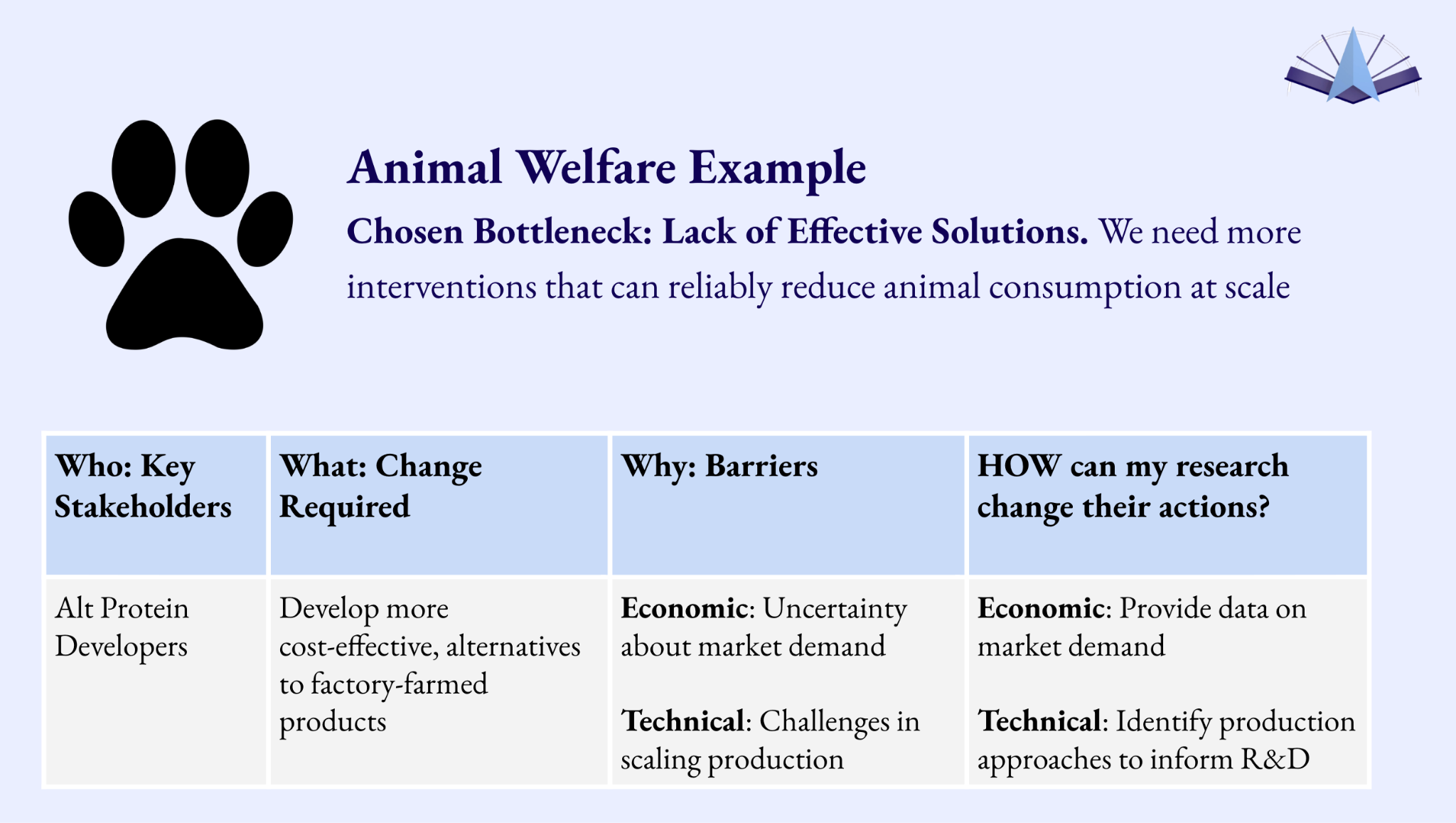
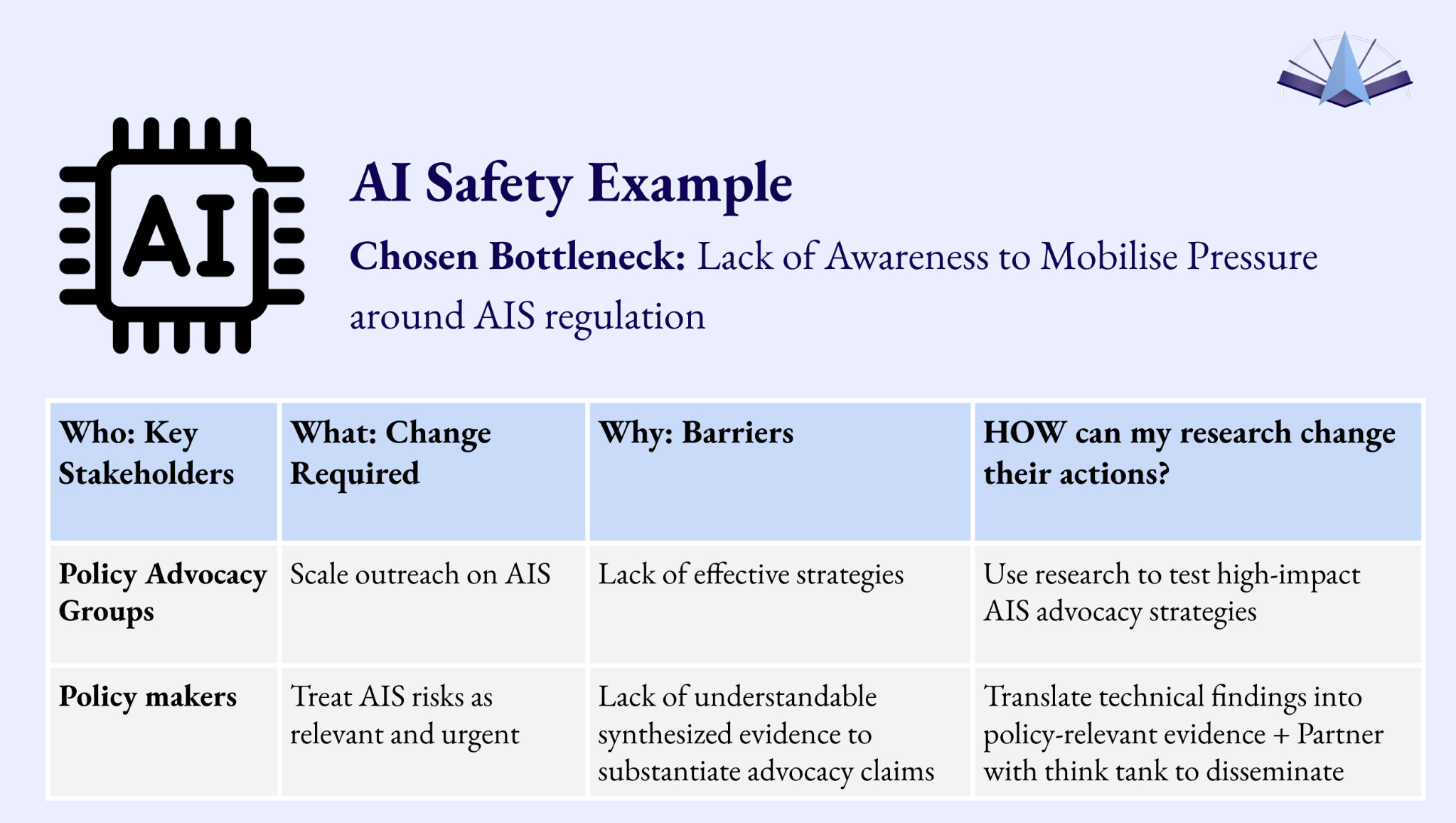
Table of Stakeholder-Bottleneck Mapping
Examples of Bottleneck-Stakeholder Mapping
2. Stakeholder Outreach: From Theory Into the Real World
After completing your stakeholder mapping, the next step is to start reaching out to the people and organizations that can actually move the needle on your research problem. This is about bringing your thesis out of the abstract and into the real world. By connecting with experts, implementers, funders, and organizations, you can validate your research questions, get mentorship, and open doors for collaboration that make your work more impactful.
Why reach out to key stakeholders?
Think of stakeholder interviews not just as a fact-finding mission - they are an opportunity to test assumptions and expand the impact of your thesis through partnerships with people who are already working on a problem you care about.
Test and refine your Theory of Change (ToC): Stakeholders can challenge or validate specific assumptions in your ToC and can help you know whether your thesis question and planned outputs are actually useful or feasible in practice. For Example, if your ToC assumes that policymakers will act on evidence from AI safety research, an interview with policymakers or policy think tanks can reveal whether that assumption is realistic or if there are other additional bottlenecks that need to be addressed.
Identify opportunities for collaboration or co-development of outputs: Engaging with stakeholders can help you produce research that is more ambitious and impactful than what you could achieve on your own. For example, partnering with a policy think tank could allow you to co-author policy briefs, boosting both reach and credibility. Similarly, collaborating with academic researchers on a paper could give you access to data, methods, or mentorship that strengthens your thesis and enhances its rigor. By working alongside others already active in the field, your research can become more relevant, actionable, and connected to real-world impact.
Work directly with the people your research hopes to reach: Instead of hoping your findings somehow make it to the right hands, engaging with stakeholders lets you understand their needs firsthand. This ensures your research is relevant, actionable, and directly supportive of the people or organizations you hope to impact.
Start making a difference now: Engaging with stakeholders through your thesis means your impact can begin with your research now, not just in theory. By connecting with the people and organizations your research is meant to help, you can contribute to real-world solutions, test ideas in context, and make meaningful progress while you’re still in the research phase - rather than waiting until your thesis is “finished” or after you’ve graduated.
Tap into deep expertise and institutional knowledge on a problem you care about: Even if you have questions about their current approaches, stakeholders have spent years working on the problem you care about. They know what works, what doesn’t, and why certain strategies succeed or fail. Early interviews can save time by helping you identify the most valuable sources of information and the right next experts to consult - rather than depending on your own research to figure the whole field out!
Test your fit and build your ideal career path: Outreach gives you a chance to explore what working in this field would actually be like. You can experiment with different roles, learn what suits your skills and interests, and start building a network and experiences that align with your long-term goals.
Key Recommendations for Outreach
Co-create your research question with the people you hope to impact, rather than only finalising it in isolation and presenting it to them afterward.. One really effective way to tackle uncertainty about both your thesis impact and career is to work directly with people who are actively doing the work in your field.
Frame your first outreach as a 30-45 minute expert interview, not a request for ongoing help. Many experts are far more receptive to this than you'd expect, since it prioritises learning and relationship-building first, with collaboration following naturally if it makes sense later.
Let the relationship develop naturally afterward, whether that becomes an informal advisor relationship, occasional feedback, or a more substantial collaboration. This could look like:
Potential formal/informal advisor for your thesis, ranging from one-off calls, to email feedback, to more structured mentorship: Once you've established initial contact, these relationships can develop into ongoing advisory arrangements where stakeholders provide guidance on your thesis research.
Potential collaborator - providing data to work together, more structured internship opportunities in the future: The most substantial form of engagement involves developing collaborative relationships where you contribute meaningfully to their ongoing work.
General Strategies for Effective Outreach
Direct Contact: Reach out to experts or academics via institutional email, typically available on their professional or departmental webpages. : Review authors of key publications, speakers at conferences or webinars, faculty conducting related research, and authors of influential books or reviews. Include early-career researchers, postdoctoral fellows, or graduate students who are actively working on relevant projects.
Targeted Points of Contact: For larger organizations, identify project leads or team members who have directly contributed to work relevant to your thesis, rather than senior executives. These individuals are often more reachable, operationally involved, and invested in the outcomes of their projects.
Leverage Junior and Near-Peer Positions: Consider engaging with individuals a few steps ahead in their careers, such as graduate students, postdoctoral researchers, early-career staff, or program managers. These individuals often:
Have practical, hands-on experience in the problem space.
They are more accessible and receptive to mentorship or collaboration requests.
Can provide highly actionable guidance, introductions, or even co-collaboration opportunities.
Offer insights into the day-to-day realities of working in the field, helping you evaluate fit and prepare for future career steps.
Show alignment: Make it clear you know their work, why it’s relevant to your research, and why their perspective matters. Specific references to projects, publications, or initiatives make your outreach stronger.
Referrals: Ask each interviewed expert for recommendations of others you should speak with in order to surface new expert referrals you may have overlooked.
3. The Emotional Barriers of Outreach
We wanted to share that for most people, the hardest part of this week isn't finding stakeholders, it's actually hitting send! Oftentimes, a voice may come up, like “who am I to be emailing this person, or they're going to know how unqualified I am”. And you’re definitely not alone in experiencing imposter syndrome - we all experience it in different degrees and contexts!
A few things we wanted to share to encourage you when this comes up:
This feeling is so common, universal, and NOT a sign you're failing! Luisa Rodriguez, a researcher at Rethink Priorities, has written really openly about feeling this even years into her career, including around this exact kind of outreach. If people deep into their careers still feel it, that tells you something, the feeling just doesn't track reality very well.
The experts you're nervous about were once exactly where you are. Most people you'll reach out to remember being a student cold-emailing someone senior, and many genuinely enjoy being that person for someone else now. You are also giving them the gift of being able to share the work they spend their lives on!
People are often way more receptive than you'd expect. And the people who do reply are almost always genuinely kind about it - most people love being asked about their work.
A "no" or silence really isn't a judgement on your worth or value. Oftentimes, this might mean a busy week or a full inbox, not a judgement on whether your question or your work matters. And rejection can be reframed as realignment to opportunities and people who are more aligned with your path!
You don't need permission to be curious. Wanting to learn from someone's work is itself a beautiful and good enough reason to reach out!
And honestly, you're on the same team! You and the person you’re reaching out to both want to see this problem taken seriously, and that shared mission is real common ground that you can build on.
We also recommend grounding and reminding yourself before sending a batch of emails, on your mission, and on what's actually driving you to do this work in the first place. Oftentimes, our nervousness is just a sign for how deeply we care about this going well, and we can tap into being grateful that we have this intention for the world to be a better place!
When your outreach is successful, the next step will be actually having a conversation with these key stakeholders! Stakeholder interviews are where your research moves from theory into the real world. By speaking directly with experts, practitioners, and potential beneficiaries, you gain insights and opportunities for collaboration you can’t get from papers or reports alone.
Key Reminders for Effective Interviews
Stakeholder interviews are about curiosity, learning, and building relationships. Experts are human - not infallible authorities - so approach every conversation with openness, respect, and confidence that your perspective matters. These conversations are opportunities to test assumptions, refine ideas, and expand your network of stakeholders who are working on a problem you care about.
Use stakeholder interviews to address your key uncertainties: Use interviews to test the assumptions that matter most for your thesis. For example, if you’re unsure whether your research will meet the needs of a key stakeholder group, interviews help you check what they actually want and need.
Ask the right questions to the right stakeholders! Different stakeholders have different expertise. Make sure the person you’re speaking to can meaningfully answer the questions you’re asking. For instance, beneficiaries might not know the details of the methodology, and academics might not fully understand real-world implementation challenges.
Ask your ideal direct users of your research what they want/need (the people next in your ToC). Seek input from the people who will actually use or benefit from your research. For example, Faunalytics interviews animal advocates to figure out what evidence would be most useful and then designs research to fill those gaps.
Follow your curiosity: Let your natural curiosity guide the conversation. You don’t need to know everything or say the “right” thing - honest questions often spark the most useful insights.
Look for potential mentors or collaborators: Some experts may be interested in supporting your research or career. Building a good impression and professional relationship could open opportunities for co-authorship, data access, or guidance on your thesis.
Prepare thoughtfully: Doing your homework shows respect for their time and helps you ask better questions. Read relevant papers, reports, or summaries they’ve produced. Have your questions ready and know which are most important to prioritse.
Ask comparative or context-focused questions: Experts may not be able to provide exact probabilities or precise numbers, but they can offer valuable insight when asked to compare approaches, interventions, or strategies. For example, “Does intervention X seem more effective than Y in this context?” is more actionable than asking for exact figures.
Pause and give them space: Allow time for reflection after each response. Silence often encourages experts to expand on points they might otherwise omit.
Reminder: Limitations of Expert Input
Experts can provide valuable guidance, but they might not have the exact expertise to evaluate your specific work. Their advice can be influenced by biases, personal experience, or the limits of their perspective. Just because an expert says “don’t do this” doesn’t mean it’s gospel - treat their input as guidance, not a final verdict.
💡 Takeaway: Use expert insights alongside other evidence, compare perspectives from multiple sources, and critically evaluate how their advice applies to your research.
How to Structure the Interview
Stakeholder interviews are an opportunity to gather insights that can help you refine your thesis question, validate assumptions in your Theory of Change, and identify opportunities for collaboration or impact. The goal is to have structured conversations that balance understanding the problem landscape, exploring potential solutions, and seeking guidance on your specific research ideas or career path.
When preparing for these conversations, you can focus on:
Problem Understanding: Learn about the key challenges, bottlenecks, and knowledge gaps in the field.
Solution & Action Landscape: Understand who is working on the problem, which approaches are effective, and where opportunities for intervention exist.
Thesis-Relevant Insights: Gather feedback on your research questions, identify missing evidence, and explore opportunities for co-development or collaboration.
Career & Mentorship: If relevant, use the conversation to understand the field, career pathways, and skills you should prioritize.
Sample Interview Questions
You can use the sample interview questions below as a guide. They are organized to cover background, problem landscape, solutions, thesis-specific insights, and career advice, ensuring that each interview is both focused and actionable.
What to do after the interview
After a stakeholder interview, the real value comes from turning the conversation into insights and action. Here’s a practical approach to what to do after your interview:
Send a follow-up email:
Thank them for their time and insights, and mention any key points from your conversation that were particularly helpful.
If relevant, you may politely ask if they’re open to future collaboration or if they could connect you to others who might offer additional perspectives.
Synthesize the interview for your own notes:
Summarize key insights, takeaways, and new questions that arose.
Note any assumptions that were confirmed, challenged, or need further investigation.
Highlight potential collaborators, resources, or data sources mentioned.
Plan your next steps:
Decide whether you need to interview more stakeholders in this area or shift focus to a different type of stakeholder.
Reflect on whether your thesis question or approach needs adjusting based on what you learned.
Identify opportunities for collaboration, data access, or mentorship that could strengthen your research and make it more impactful.
We would love to support you in your journey of designing your impactful thesis and career. You can see our open programs here.