
Choosing which problem to work on is one of the highest-leverage decisions you'll make, not just for this thesis, but at many decision points across your life and career. This week is designed to help you land on a problem you genuinely believe matters and where you're well-placed to make a real difference.
As a concrete illustration of why this choice matters. Consider two diseases that each affect large numbers of people. Multiple Sclerosis (MS) accounted for roughly 0.034% of the global disease burden in 2021 (IHME). Malaria accounted for roughly 1.91%, around 54 times as much. Contributing meaningfully to solving either disease would be a genuinely valuable contribution to reducing suffering. But if you could only make progress on one, a comparable amount of effort directed at malaria would likely reduce far more of the global disease burden than the same effort directed at MS.
This isn't to say MS research is a bad choice. It's to illustrate a simple but easy-to-forget point: within any category of "important problem," some options will help you use your resources, time and effort to go dramatically further than others. Choosing quickly and without much thought may result in you working on a problem that's trivial, already solved, or too difficult to realistically move forward - such that even amazing execution can end up producing very little real-world impact. That's what the rest of this week is designed to help you avoid!
Links to Ikigai. Building on the ikigai concept introduced in Week 1, this framework provides a powerful lens for selecting high-impact problems linked to what the world needs. Ikigai emphasizes the intersection of what the world needs and where your unique skills and strengths can make a difference. By focusing on problems that lie at this intersection, you can direct your energy toward work that is not only meaningful and fulfilling for you but also truly impactful for others.
You may be at a stage now where you’re certain you want to find a problem that is worth you spending a lot of resources, time and effort on - such that the impact will be non-trivial and real! However, when navigating the world - which has many different potential areas you can contribute to - how can you approach selecting a problem to invest your efforts into? One of the key frameworks we recommend for assessing potential problems to work on is the Importance-Tractability-Neglectedness (ITN) framework.
“The Importance-Tractability-Neglectedness (ITN) framework is a set of mental shortcuts (often called heuristics) that allow you to more easily narrow in on problems that you can have an especially large impact by solving, if you were a good fit for solving them” (Non-Trivial Research Foundations Program)
This framework breaks down the potential impact of working on a problem into three key factors:
The ITN framework can help you avoid common traps that may reduce the real-world impact of your work:
By explicitly assessing problems along these three dimensions, the ITN framework helps prioritize areas where your work is most likely to create meaningful, measurable change. It also highlights failure modes, such as working on interesting problems that are already saturated with effort.

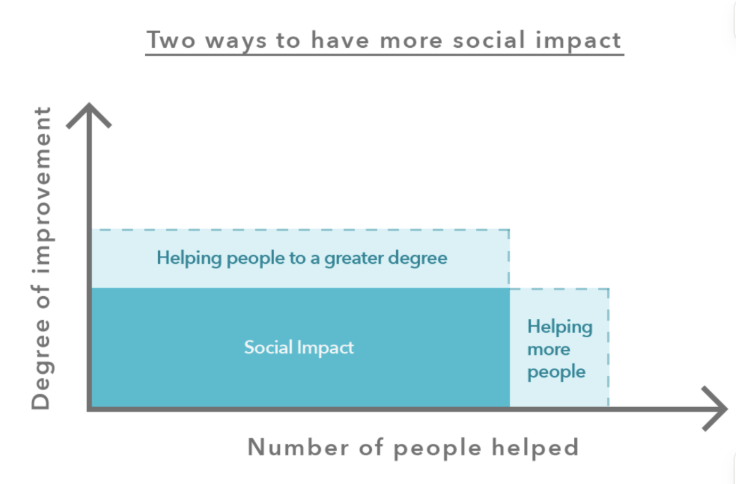
There are two ways to think about how you may be able to increase impact:
“Helping more people” (horizontal extension) – moving along the x-axis increases impact by reaching more individuals, even if the improvement per person stays the same.
“Helping people to a greater degree” (vertical extension) – moving along the y-axis increases impact by improving outcomes for each individual, even if the number of people helped stays the same.
⭐ Key insight: You can increase your impact by either increasing the number of beings you help, deepening the improvement for each being, or ideally, doing both simultaneously!
The following examples illustrate common scenarios where a problem may fail to maximize impact along one or more ITN dimensions.

Note: ITN is not the only, or necessarily the best, way to prioritize between causes. Treat ITN as a set of useful shortcuts for narrowing your options quickly, not a strict rulebook. Before you lean on it too heavily, it's worth asking what this framework might be missing, and which kinds of causes it may be systematically privileging over others!
In this week’s worksheet, we’ll work on ranking high-impact problems that you are drawn to working on! Now that we have a framework we can use to select problems, we can look at the landscape of different problems that exist in the world - that may be really impactful for you to work on.
Expansion before committing at this early research stage. One most common pitfall we see is NOT considering enough options in the first place. Oftentimes, we may quickly feel biased towards our initial ideas - a form of confirmation bias where you stop looking once something feels good enough. At the beginning stages of creating your research project, we strongly recommend considering more options than you may initially think first. This is because the cost of considering (and then discarding) a bad idea is low, since you're not committing any real time to it yet. But, the cost of missing a really impactful idea is high, since you’ll never spend your hundreds of hours working on it.
A map of cause area clusters. There are many different organisations and thinkers who have spent years researching which problems tend to be most important, neglected, and tractable at the margin. This is by no means exhaustive, but helpful as a jumping off point for you to consider problem areas you may not otherwise have!
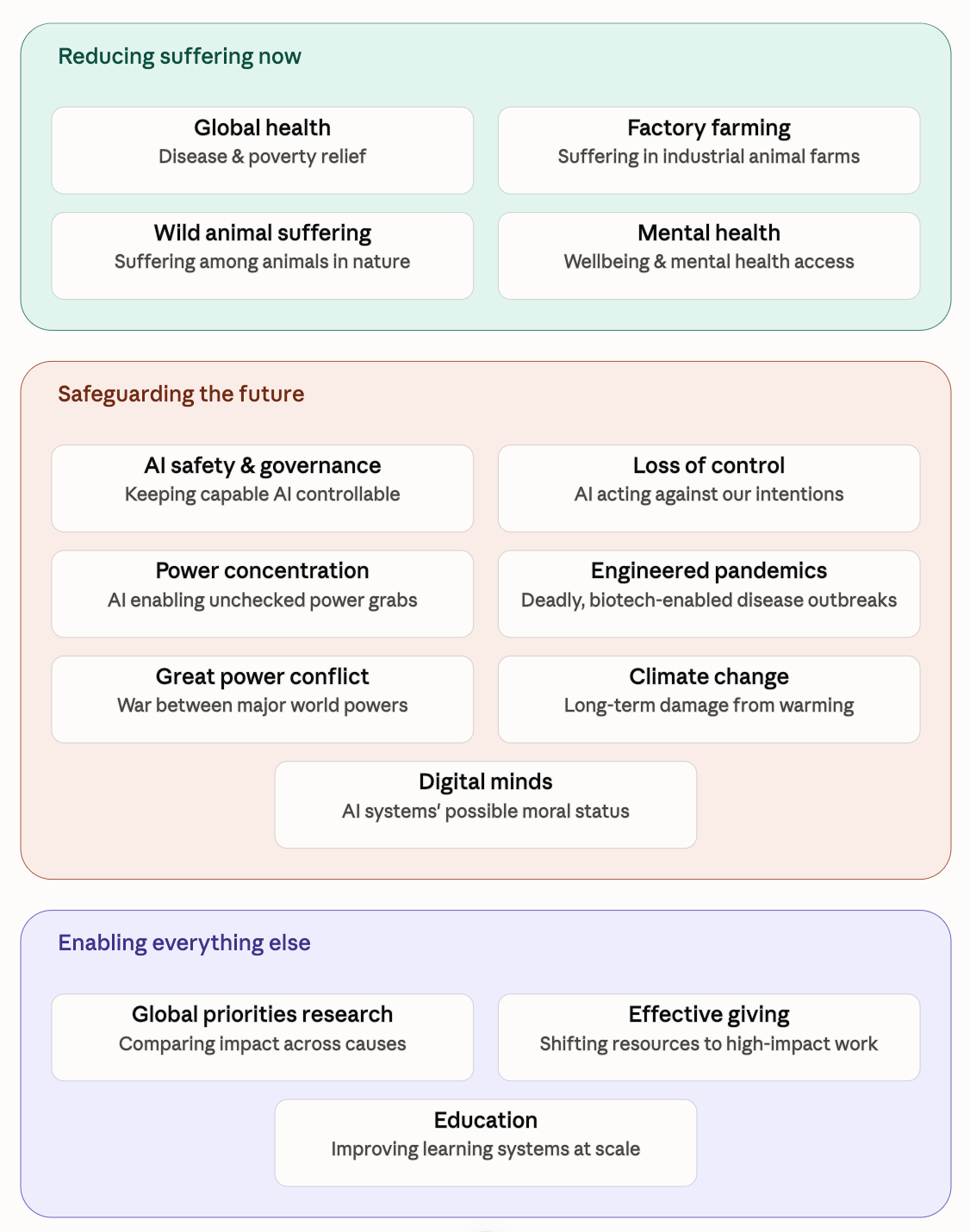
One key resource we recommend spending some time on is 80,000 hours - a non-profit that helps people find fulfilling careers that make a big positive impact. They frequently update their list of pressing problems and explain:
“We prioritise problems that are especially large in scale, neglected by others, and solvable — because that’s where additional people can usually make the biggest difference. This list is our best guess at which problems score highest on those factors, and therefore most need more people working on them. This list is constantly evolving, and we expect to revise it over time. There are also many reasonable ways to disagree.”
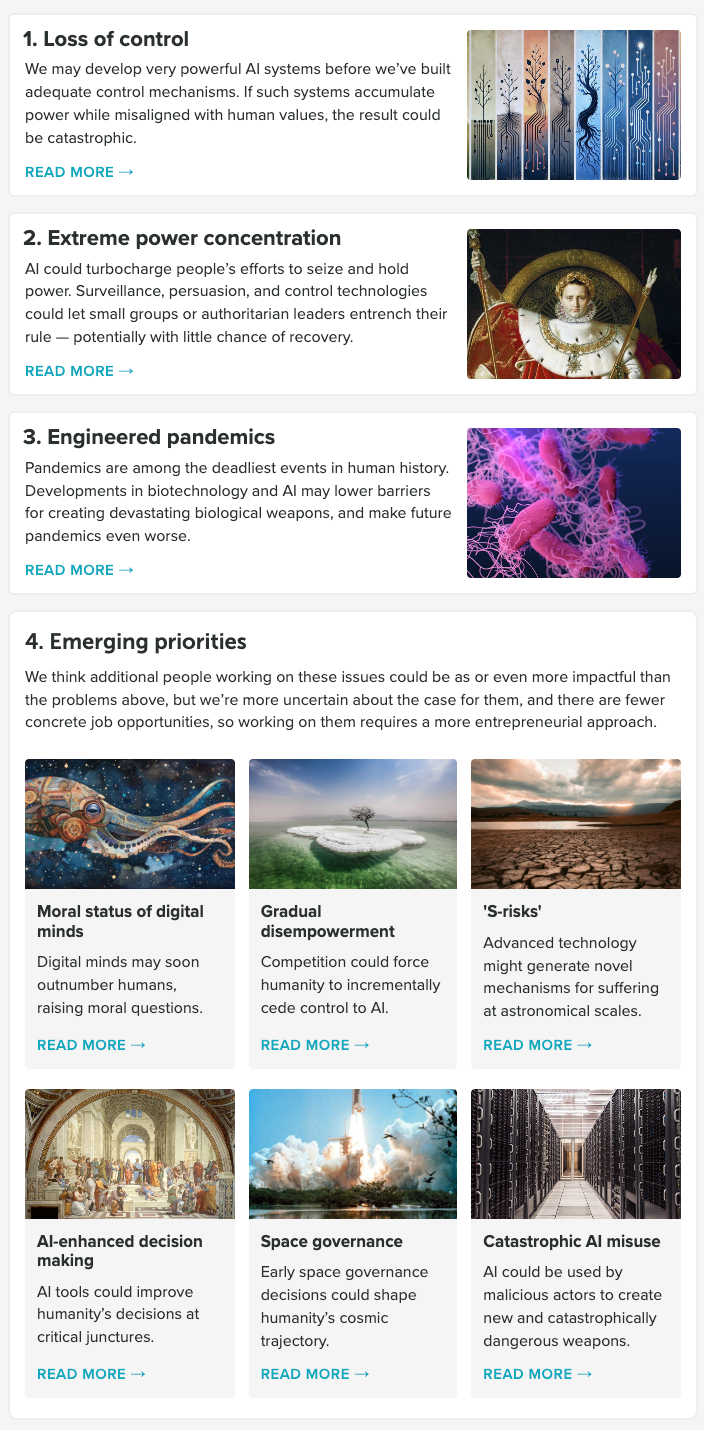
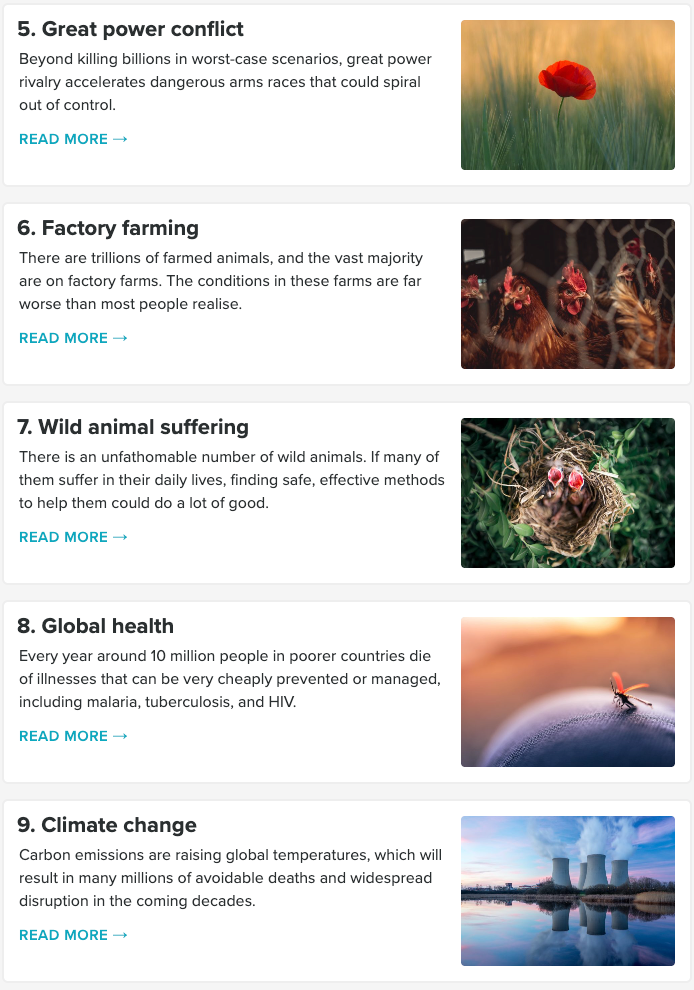
Source: List of pressing world problems (80,000 Hours)
As a next step, please pick one of the readings below to look through - to help expand your current set of potential impactful problems that you could work on. Remember that none of these lists can tell you exactly what to work on. As you read, it's just as important to notice how you relate to a given problem (does it energise you? How does it relate to your Ikigai?) as it is to notice how the problem scores on paper. We'll come back to that in the worksheet!
Finally, we wanted to highlight that while the ITN framework is helpful for analysing the evidence and current state of a problem area, it doesn't, on its own, factor in how you relate to the problem you'd actually be working on. A problem can score well on paper and still be the wrong choice for you. A problem that scores more modestly can sometimes be exactly right, if it's one you can bring real, sustained energy to.
As such, in this week's worksheet, we'll ask you to weigh your ITN analysis alongside a more personal reflection: of your candidate problems, which one do you feel most energised by, most naturally suited to, or most quietly pulled toward?
The goal is to find a balance between what the world needs (based on evidence and analysis) and also what sustains you and brings you meaning and purpose. Even a problem that scores highly on importance, neglectedness, and tractability will be hard to sustain effort on if you don't feel personally engaged by it. On the flip side, we may also fall into the trap of investing a lot of our efforts into a problem that doesn’t genuinely make a difference for the lives of other beings.
By connecting ITN to your Ikigai, the intersection of what the world needs, what you can contribute, and what gives you a sense of fulfilment, you can select a problem that's both impactful and personally sustainable.
Having a strong personal fit (i.e. skills) and a strong sense of meaning and purpose doesn't just make the work more enjoyable, it can substantially increase your impact. When you're genuinely engaged and well-suited to your work, you're more likely to develop real expertise, notice opportunities others miss, persist through the inevitable setbacks, and sustain your impact well beyond this thesis!
Additional resources on personal fit
📚 Additional Resources on ITN
Examples of problem profiles using the ITN framework
