A weighted factor model (WFM) is a quantitative decision-making tool that ranks a set of options based on multiple criteria, each assigned a relative importance (weight). This approach ensures that decisions are structured, evidence-based, and tailored to the decision-maker’s priorities.
For example, imagine selecting a book for a vacation. Instead of choosing randomly, you consider key factors such as:
Book quality (e.g., GoodReads rating)
Appetite for reading it now (e.g., personal excitement on a scale of 1-5)
Reading time required (e.g., estimated time to complete the book)
Physical weight of the book (important for travel convenience)
However, not all criteria are equally important. Book quality and personal excitement likely outweigh book weight. By assigning weights to each factor and standardizing the scores, a final ranked list emerges, guiding your decision rationally.
Key Components of a WFM
Options (in the example above, these were books)
Criteria (e.g., quality of the book)
Weights are assigned to each criterion.
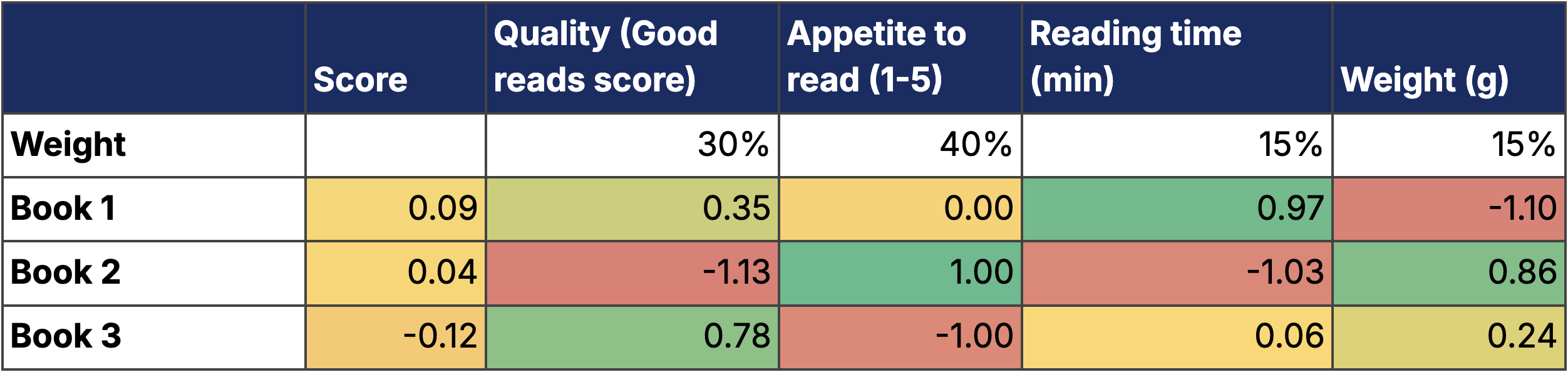
Example of a WFM for a book to read
Credits to Ambitious Impact Research Fellowship Program Materials (Owner: Morgan Fairless)
2. Why use a WFM for Career Decisions?
Career decisions require balancing multiple factors, including impact, financial security, personal fulfillment, skill development, and more.
A WFM provides a systematic framework to assess career choices holistically. By assigning importance to different factors and scoring alternatives objectively, individuals can make more informed and value-aligned career decisions. This approach helps avoid biases such as: recency bias (overemphasizing recent opportunities while neglecting long-term career trajectories), confirmation bias (prioritizing career paths that reinforce pre-existing beliefs rather than considering all options objectively), and more.
Additionally, a WFM can help individuals recognize counterintuitive results — for example, a career path that initially seems less appealing may score higher when all relevant factors are weighed systematically.
3. How to construct a weighted factor model for your career?
A Weighted Factor Model (WFM) is a structured decision-making tool that helps prioritize options based on multiple criteria. This framework can be effectively applied to career decision-making, providing a clear, data-driven method for comparing potential career paths.
Steps to Apply a WFM to Career Choices
Step 1: Clarify Your Goal: Before constructing a WFM, define what you aim to achieve. In career decision-making, this might include selecting a job that maximizes direct/indirect impact, personal fulfillment, long-term growth, financial stability, etc. Having a clear goal ensures that your criteria remain relevant and decision-making is focused.
Step 2: Set Up Your Options: List all career options to be evaluated. This might include specific job offers, industries, graduate programs, or entrepreneurial opportunities.
Step 3: Determine the Criteria: Selecting the right criteria is crucial for making informed career choices. These should reflect personal values, professional aspirations, and external constraints. Characteristics of Good Criteria:
Relevant: Directly related to career goals (e.g., salary, skill development, job satisfaction, impact potential).
Useful: Data should be available for most options and allow differentiation.
Practical: Feasible to assess without excessive time investment.
Examples of criteria may include
Impact Potential (measured using the Importance-Neglectedness-Tractability (INT) framework)
Personal Fit (skills, interests, and long-term growth opportunities)
Salary & Financial Stability (to enable donations or personal well-being)
Network and Learning Potential (access to mentorship or personal well-being)
Step 4:Assign weights to each criterion based on its importance. Weights should reflect personal priorities, ensuring the final decision aligns with core values. Allocate relative importance to each criterion (e.g., impact = 40%, personal fit = 30%, salary = 20%, network = 10%).
Step 5: Score each option (and standardise with template)
Step 6:Analyze and Interpret Results: The WFM output provides a ranked list of career options. However, quantitative results should be supplemented with qualitative considerations, such as:
Personal intuition – Does the highest-ranked option feel right?
Networking feedback – Insights from experienced professionals
Long-term vision – Alignment with broader life goals
Alternatively, you can duplicate this template and fill it in with your own options and criteria: Example Career WFM
5. Other Use Cases of WFMs
Beyond career selection, WFMs can be applied to various domains, especially within EA:
Research Prioritization: Academics can use WFMs to select high-impact research questions, weighing factors such as societal need, feasibility, and existing work.
Grant Allocation: Philanthropic organizations can rank funding proposals based on cost-effectiveness, expected impact, and scalability.
Charity Evaluation: GiveWell and Open Philanthropy use quantitative models similar to WFMs to determine the most effective charitable interventions.
Policy Decision-Making: Governments can use WFMs to assess policy options, ensuring that resources are directed toward the most impactful initiatives.